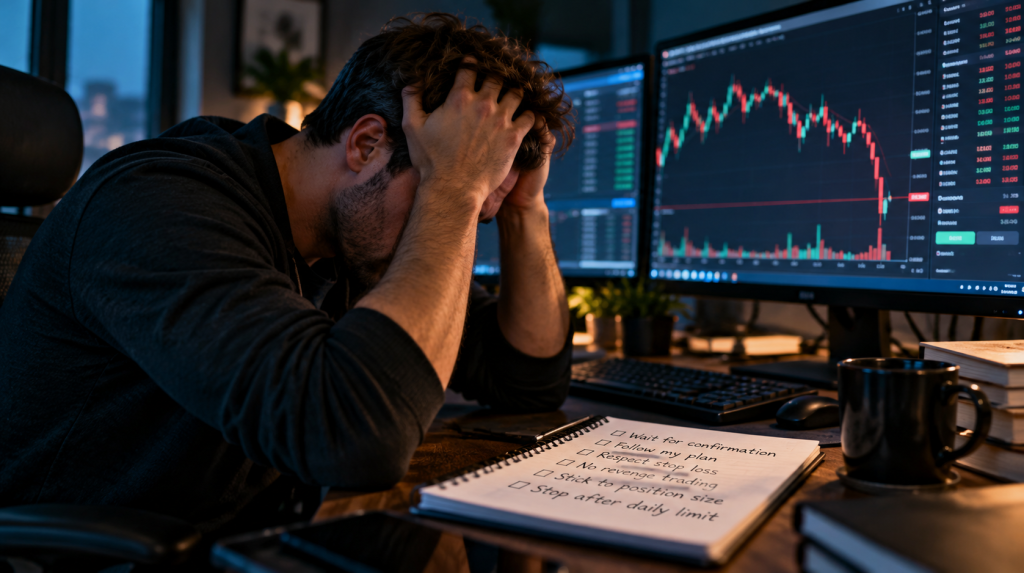
You know the setup.
You’ve seen it before. You know what confirmation you’re waiting for. You know where the stop should go. You probably even told yourself before the market opened:
“Today, I’m sticking to the plan.”
Then price starts moving.
A candle pushes quickly. Another follows.
And suddenly, you’re in a trade you never planned to take.
Sound familiar?
This is one of the hardest parts of trading to accept: knowing the right thing to do doesn’t automatically mean you’ll do it when emotion enters the picture.
That doesn’t necessarily mean your strategy is bad.
Sometimes the real challenge is what happens between the plan you made calmly and the decision you make under pressure.
Most traders already know what they did wrong
After a difficult session, traders often don’t need someone else to point out the mistake.
They already know.
“I entered too early.”
“I chased the move.”
“I moved my stop.”
“I took another trade because I wanted the money back.”
“I knew I should have stopped.”
That tells us something important.
The problem often isn’t knowledge.
The rule was there.
The trader understood it.
But in that particular moment, something felt more urgent than following it.
That’s where psychology starts to matter.
When you look at a chart later, waiting for confirmation seems obvious.
But when price is moving quickly and you feel like you’re being left behind, waiting suddenly feels uncomfortable.
Respecting a stop seems simple when you’re calm.
But when the trade is going against you and you’re convinced it might turn around, accepting the loss can feel much harder.
Stopping for the day sounds sensible.
Until you’re down £200 and the thought appears:
“One decent trade and I can get it back.”
The rule hasn’t changed.
Your emotional state has.
And once that happens, the plan can start feeling negotiable.
A winning trade can reinforce the wrong behavior
This is one of the most dangerous things about trading psychology.
Sometimes the market rewards you for breaking your own rules.
Imagine your plan says:
Wait for the breakout. Wait for the retest. Then enter.
But price starts moving and you don’t want to miss it.
So you enter early.
The trade works.
You make £300.
It feels like a good decision.
But was it?
The result was positive.
The process wasn’t what you planned.
Those are not the same thing.
And this is where traders can accidentally train themselves into bad habits.
If you only look at P&L, your brain remembers:
“Entering early worked.”
But the better lesson might be:
“I broke my rule and the market happened to reward me this time.”
That distinction matters.
Because the next time you enter early, the outcome may be completely different.
The market doesn’t consistently reward discipline on every trade.
You can follow your process perfectly and lose.
You can ignore your rules completely and make money.
That’s why one trade tells you very little.
What matters is what your decisions look like over dozens or hundreds of trades.
FOMO is really discomfort with being left behind
FOMO is a good example.
You’re watching the market.
You planned to wait for a pullback.
The pullback doesn’t come.
Price keeps moving.
Another candle.
Then another.
At first, you’re thinking:
“I’ll wait for my setup.”
A minute later, the thought becomes:
“This is going without me.”
Then:
“If I don’t enter now, I’ll miss the whole move.”
And suddenly you’re in.
What changed?
Not necessarily the setup.
Your discomfort increased.
Watching a move happen without you can feel like losing an opportunity, even though you haven’t actually lost anything.
That feeling creates urgency.
And urgency is often where good trading rules disappear.
Sometimes the trade keeps going and you feel relieved.
Sometimes you enter near the end of the move and price reverses.
But the most useful question isn’t:
“Why did this trade lose?”
It might be:
“What was I feeling just before I abandoned my plan?”
That’s where the useful information is.
Revenge trading is often an attempt to remove an uncomfortable feeling
Revenge trading can look irrational from the outside.
But emotionally, it makes a lot of sense.
You take a loss.
Maybe it was completely normal.
The setup was valid.
The risk was controlled.
The stop was respected.
From a process point of view, nothing terrible happened.
But emotionally, you don’t want to end the session with the loss.
You want to fix it.
The next trade starts to feel more important than it really is.
You’re no longer just looking for a good setup.
You’re looking for relief.
Relief from the loss.
Relief from frustration.
Relief from feeling wrong.
That’s when standards can quietly drop.
A trade you would normally ignore suddenly looks “good enough”.
Then another.
And before long, the original loss isn’t the real problem anymore.
The reaction to the loss is.
At that point, you’re not really trading the market in front of you.
You’re trading your previous trade.
Your journal should capture more than the result
Most trading journals are good at recording what happened.
Entry.
Exit.
Profit.
Loss.
Maybe a screenshot.
Useful information.
But it doesn’t always explain why the trade happened the way it did.
Imagine two traders finish the day up £500.
Trader A waited patiently, followed the plan, controlled risk and stopped when planned.
Trader B chased trades, increased size after a loss and got lucky on the last one.
Same P&L.
Very different behaviour.
Now imagine two traders finish down £200.
One ignored the plan completely.
The other followed every rule and simply took a normal strategy loss.
Again, same P&L.
Very different day.
This is why separating outcome from behaviour matters.
If you only record money, you can miss the pattern that actually needs attention.
The goal probably isn’t to become emotionless
Traders sometimes talk about discipline as if the goal is to remove emotion completely.
That’s probably not realistic.
You’re going to feel frustrated.
You’re going to feel tempted.
You’re going to feel FOMO.
You’re going to have days where taking the stop feels harder than usual.
The goal isn’t necessarily to stop those feelings from appearing.
It’s to become better at noticing what happens after they appear.
Maybe you tend to break rules after your first losing trade.
Maybe you trade patiently early in the session but become more impulsive later.
Maybe missing a big move makes you much more likely to chase the next one.
Maybe your worst days aren’t caused by the first loss.
They’re caused by the three trades you take trying to recover from it.
These patterns are much more useful than simply saying:
“I need more discipline.”
That phrase is too vague.
A better improvement might be:
“After every losing trade, I’ll step away for ten minutes before looking for another setup.”
Or:
“If I miss the move, I won’t enter unless my original setup appears.”
Now you have something observable.
Something you can practise.
Try asking a different question after the trade
Instead of immediately asking:
“How much did I make?”
try asking:
“What was happening in my head when I made that decision?”
Did I feel rushed?
Did I feel afraid of missing out?
Was I trying to recover a loss?
Was I bored?
Was I looking for a trade because the setup was there, or because I wanted to be in the market?
Did I follow the rule I had already decided mattered?
Those questions can feel uncomfortable.
But they’re often more useful than staring at the P&L.
This is one of the reasons I started building ZenDisciplr
I wanted a way to look beyond whether a trade finished green or red.
Did I follow the Playbook?
Which rules did I follow?
Which rules did I break?
Was the trade planned?
Was I chasing?
Was I reacting emotionally to the previous trade?
And most importantly:
Are the same behaviours showing up again and again?
That’s the thinking behind ZenDisciplr.
It isn’t designed to tell you what to buy or sell.
It’s designed to help you understand the decisions behind your trades.
Because consistency may not come from finding one more indicator.
Sometimes it comes from understanding yourself well enough to recognize the moment when you’re about to abandon your own process.
And learning to respond differently next time.
That is probably one of the hardest parts of trading.
But it may also be one of the most valuable.
Leave a Reply